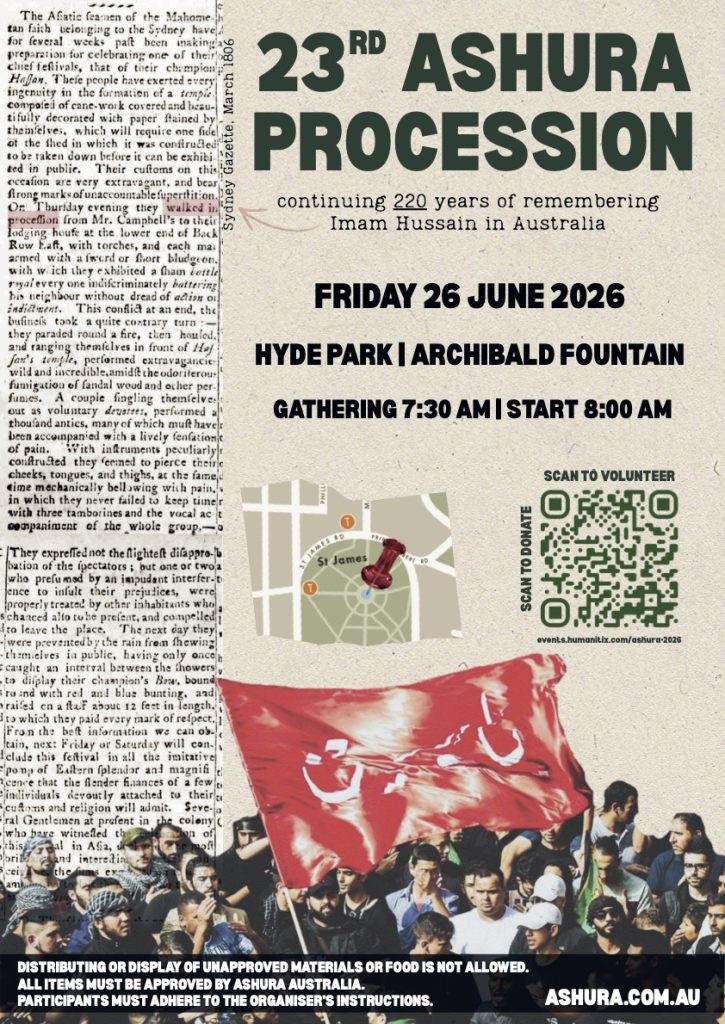
The Day Of

Ashura

Please support and promote the cause of Imam Hussain by donating or volunteering to the Ashura Procession in Sydney through:

https://events.humanitix.com/ashura-2026

Ashura © All Rights Reserved

FAQs

[qa]

What is

Ashura?

What is Ashura?

Ashura is an annual day of morning on the 10th day of Muharram (the first month of the Islamic Lunar Calendar). It is an annual event which marks the martyrdom of Imam Hussain (the... Read More.

What is Ashura?

Ashura is an annual day of morning on the 10th day of Muharram (the first month of the Islamic Lunar Calendar). It is an annual event which marks the martyrdom of Imam Hussain (the prophets grandson) in 680AD in Karbala Iraq, for refusing to submit to the tyranny of the Caliph at the time Yazid.

The portrait of Karbala started from a piece of land on the outskirts of a very large desert. A person by the name of Hussein was isolated in an open field in this desert. He was with his family and companions (whom did not muster even 70). On the other side stood an army that has been sent to fight him from various regions in the area reaching in excess of 30,000 soldiers (based on even the weakest of narrations).

At one place on the field lie many palm trees and behind them a small river called the Al Alqami River, which branched from the Euphrates River. This place was where the animals quenched their thirst, the plants sourced their nutrients and humans got their sustenance that God has provided as a gift.

This large army prohibited Hussein’s camp from drinking water after he was asked to choose between submitting to the rule of a thoughtless tyrant named Yazeed. Yazid knew nothing about Islam except the name of the religion. So Hussain made a choice. He chooses to die beloved and strong rather than being killed whilst weak and humiliated. He chose to be killed and cut into pieces to show to all mankind that this tyrant (Yazeed) who ruled the people and who’s followers were not Muslims and the path they follow is not related to Islam at all. He chose to be killed so that the pure Islam would last in perpetuity with his martyrdom, as the honored Prophet Mohamed stated:

“Hussein is from me and I am from Hussein”

Hussain and his companions have become eternal in front of the face of time. One would say how? The incident has occurred more than 1360 years ago so how are the personalities of the story still present with us today?

Its simple.

Look around you and witness the elements of righteousness and the elements of oppression. You will find that the light (of righteousness) is ever so bright where as the darkness (of oppression) is dark, despite the passing of time and other changes.

About Imam Hussain

Who is Imam Hussain (a.s)? The Son of Fatima Al Zahra, daughter of the Prophet of Islam, Mohammed Ibn Abdullah The Son of Ali Ibn Abu Talib, the leader of the Faithful, the... Read More.

About Imam Hussain

Who is Imam Hussain (a.s)?

  1. The Son of Fatima Al Zahra, daughter of the Prophet of Islam, Mohammed Ibn Abdullah
  2. The Son of Ali Ibn Abu Talib, the leader of the Faithful, the first believer in Islam, the bravest in God’s path, the most just in his judgements and the fairest with his people
  3. Many Quranic verses have been revealed to praise, tribute and describe his illustrious status
  4. The Prophet of Allah has showed his sincere love to him and his brother Imam Hassan in many events
  5. Many narrations from the Prophet about him and his brother Hassan have illuminated their status in this world and the hereafter
  6. Loving him has been made a compulsory deed in God’s religion, as Allah said:

    “Say (O Mohammed, unto mankind): I ask you no fee therefore except loving kindness towards my kinsfolk {42:23 Holy Qur’an}

  7. Because Hussein is of the Prophet’s progeny, saluting him 9 times every day and night is compulsory upon every Muslim, which is the number of times we salute Mohammed in our daily prayers.

The tragedy of Hussain (a.s)

Despite the great personality that Hussein was, the tragedy that followed is incomparable to any other throughout human history.  A brief summary of the tragedy goes as follows:

  • He and his family, children and companions were prohibited from drinking water.
  • His tents were burnt
  • His children were killed, including his infant child when he was taken to get some water after his mum was empty of breast milk due to the lack of water. A welter occurred in the enemy’s army; some thought he should be given some water whilst others said that none should be spared in the household of Hussein. The argument was only ended by an arrow coming from the army, piercing the infant child and ending his short life.
  • They killed all his companions and sons
  • That was not enough for them, so they darted him with stones, arrows and spears. They attacked him with swords until he fell down on the ground from the top of his horse. Despite him being the son of the Holy Prophets daughter, one person dared to sit on his chest, and cut off his head.
  • His head was cut in front of many people who were claiming to be Muslims
  • When his head was carried on the top of a long spear, all of them said “Allahu Akbar” Allah is the greatest (note how similar today is to the days which have passed)
  • His holy body was then trampled on with the horses of the enemy’s army
  • What was worse was the way in which the remaining women and children were treated when they were taken captive as prisoners from one city to another.
  • If there was no fear of public revolt, Yazeed and his army would have committed even more crimes.

How Hussein treated his enemies

This is a lesson that every human can take from this great personality.

On top of all which has been mentioned about Hussein, the opposing army also saw the greatness of Hussein themselves.

Hussein knew the intentions of the army of 1,000 knights who had come in the night to kill him. They had acquired such a thirst from marching through the desert to kill him, that by the time they met Hussein on his way to Iraq from Arabia, they were exhausted. How did he treat them?

He gave them and their horses water to drink with his own holy hands.

1300 years ago, it was Hussein who put his cheek on the cheek of his black servant while he was dying in the same way that he put his cheek on the cheek of his son Ali Al Akbar when he was dying.


Perceptions about Imam Hussain

Various theologians, politicians and others have discovered the greatness of Hussein and his revolution: Ghandi “I learnt from Hussein how to be oppressed yet victorious” "When ... Read More.

Perceptions about Imam Hussain

Various theologians, politicians and others have discovered the greatness of Hussein and his revolution:

Ghandi

“I learnt from Hussein how to be oppressed yet victorious”

“When called upon to surrender, they refused. They knew at the time that this would mean death for them. If, however, they were to submit to injustices they would disgrace their manhood and betray their religion. In these circumstances, they yielded to the embrace of death. The heads of these fine young men rolled on the battlefield. In my view, Islam did not attain its greatness by the power of the sword but entirely through the self-immolation of its fakirs.”


Charles Dickens

“ If Husain had fought to quench his worldly desires, then I do not understand why his sister, wife, and children accompanied him. It stands to reason therefore, that he sacrificed purely for Islam ” , “Charles Dickens’ Miscellanies”, p.61.


Peter J. Chelkowski: Professor of Middle Eastern Studies, New York University

“Hussein accepted and set out from Mecca with his family and an entourage of about seventy followers. But on the plain of Kerbela they were caught in an ambush set by the … caliph, Yazid. Though defeat was certain, Hussein refused to pay homage to him. Surrounded by a great enemy force, Hussein and his company existed without water for ten days in the burning desert of Kerbela. Finally Hussein, the adults and some male children of his family and companions were cut to bits by the arrows and swords of Yazid’s army; his women and remaining chilfren were taken as captives to Yazid in Damascus. The renowned historian Abu Reyhan al-Biruni states; “…then fire was set to their camp and the bodies were trampled by the hoofs of the horses; nobody in the history of the human kind has seen such atrocities.”” [Ta’ziyeh: Ritual and Drama in Iran. New York, 1979, p. 2].

The

Procession

About The

Procession

The Annual Ashura Procession Australia is a procession held every year, since 2004, to remember and promote Imam Hussain and his legacy... Continue Reading.

Aims of The

Procession

- To reflect and announce the legacy of Imam Hussain.
- To promote Imam Mahdi’s message of world peace and harmony.
- To unite people from various... Continue Reading.

Guiding Principles

Procession

The Annual Ashura Procession in Australia is guided by the following principles:

Religious supervision is under His Eminence Ayatollah Sheikh Mohammad Hussein Al-Ansari.
Our intentions are only to get closer to Allah... Continue Reading.

About the Procession

The Annual Ashura Procession Australia is a procession held every year, since 2004, to remember and promote Imam Hussain and his legacy. The various guides and aims of the event are stated in the sub-headings below. Through his reform, Imam Hussain paved the path for human unity by helping those who were oppressed. The process of bringing people together to remember him in turn fulfils this great vision.

Aims of the Procession

  1. To reflect and announce the legacy of Imam Hussain.
  2. To promote Imam Mahdi’s message of world peace and harmony.
  3. To unite people from various regions and background.
  4. To reject any act of terror in Australia or elsewhere.

Guiding Principles

The Annual Ashura Procession in Australia is guided by the following principles:

  1. Religious supervision is under His Eminence Ayatollah Sheikh Mohammad Hussein Al-Ansari.
  2. Our intentions are only to get closer to Allah, remember and promote the cause of Imam Hussain (as)
  3. We will not promote in any way the name or cause of any individual, political party, mosque, centre, organisation, business, association etc except Imam Hussain (as).
  4. We will not work to make a profit, but any donations people may provide shall be spent in the organisation and promotion of the Annual Ashura Procession.
  5. Anyone is welcome to join committee meetings from any mosque, centre, association, group or representing themselves individually (all Shia centres have been invited and will be invited every year).
  6. All those involved in organising, participating or promoting the Annual Ashura Procession agree to act within the Australian law and the ethics of our religion as well as cooperate with organisers and authorities on the day

FAQ’s

[qa search=none cat=The Procession]

Procession

Media

Get In Touch

Contact

    Get in touch

      Ashura 2026

      Ashura © All Rights Reserved